
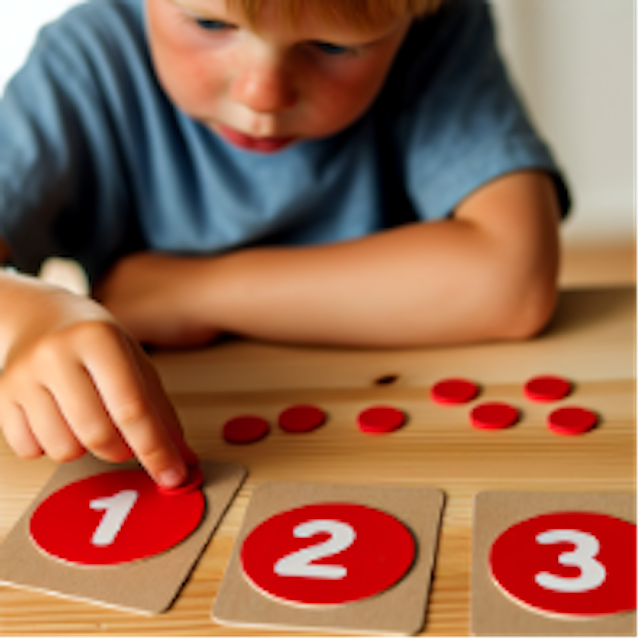
How Children Develop Mathematical Thinking Through Hands-On Experiences?
Welcome to the eleventh instalment of our “Growing Minds” blog series at Kids Channel Montessori! Today, we’re exploring how children develop mathematical thinking through concrete experiences—a process that transforms tangible explorations into powerful abstract understanding.
The Bead Chain Revelation I'll Never Forget.
Several years ago, I observed a 5-year-old working with our Montessori bead chains—colourful strands of beads grouped in tens that children use to practice skip counting. She had laid out the 9-chain, touching each bead while counting: “1,2,3,4,5,6,7,8,9,10,11…” all the way to 81.
After completing this work several times, she suddenly paused and looked up with wide eyes. “I see it now!” she exclaimed. “It’s always 9 more! I don’t even need to count all of them. I can just add 9 to the number I already have!”
What struck me wasn’t just her discovery of this pattern but the transformation happening before my eyes. Through repeated concrete interaction with these beads—holding them, moving them, seeing their groupings—she had extracted an abstract mathematical principle that would serve her for life.
This moment crystallized something I’ve observed throughout my career: true mathematical understanding doesn’t begin with memorizing procedures or symbols. It emerges from concrete experiences that gradually build toward abstraction. In that moment of revelation, this child wasn’t just learning math—she was becoming a mathematician, discovering the beautiful patterns that underlie our numerical world.
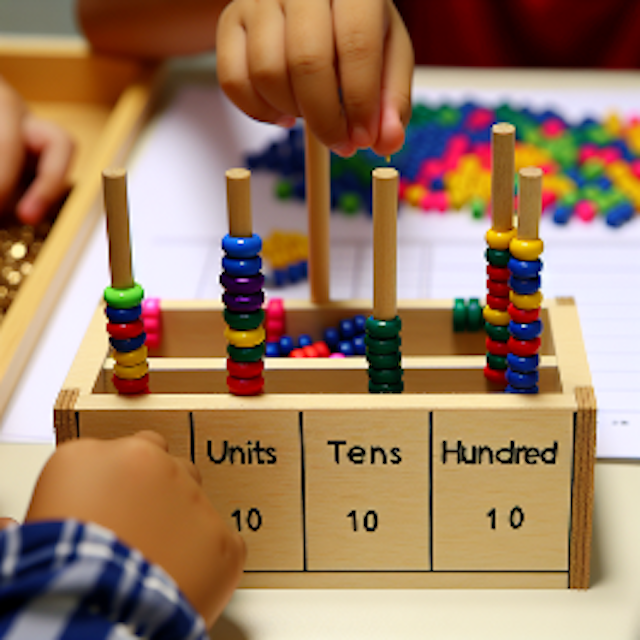
The Path to Mathematical Mind: Nature's Developmental Sequence.
Concrete Experience → Pattern Recognition → Representational Understanding → Abstract Application
Modern brain research reveals why this progression is essential:
Embodied Cognition Mathematical concepts first develop through physical interaction with the world. When children manipulate objects, their sensory-motor brain regions activate, creating neural foundations for numerical concepts. Research shows that mathematical areas of the brain evolved from sensory-processing regions, revealing that abstract thinking is literally built upon concrete experience.
The Construction of Mental Models Each time children work with concrete materials, they build and refine mental models that represent mathematical relationships. These internal frameworks become increasingly sophisticated with repeated physical experience.
The Neural Bridge As children move between concrete materials and symbolic representations, they create crucial neural connections between different brain regions. These connections form the biological infrastructure for abstract mathematical thinking.
Classroom observation: Children who experience mathematical concepts first through manipulatives demonstrate 30-40% stronger problem-solving abilities when later faced with symbolic equations compared to those introduced directly to abstract notation.
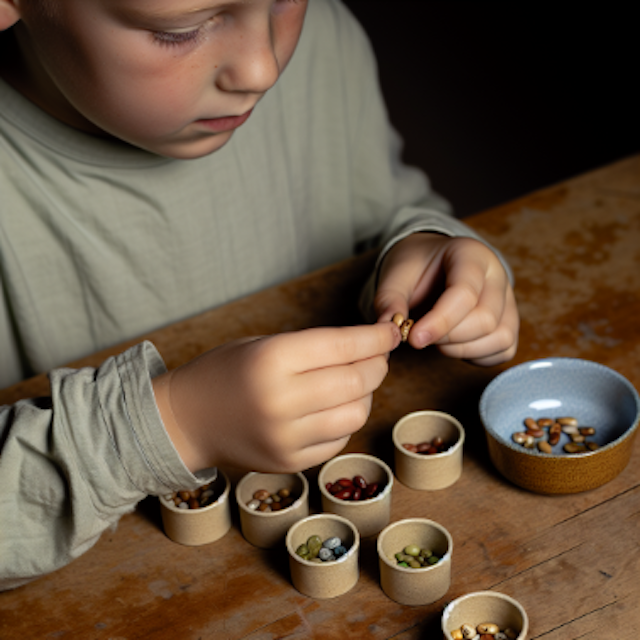
Personal experience: My son struggled with division until we revisited concrete division using beans and cups. After this physical experience, the abstract algorithm suddenly made sense to him—the connection between concrete experience and symbolic representation had been established.
The Four Stages of Mathematical Development I've Observed.
Stage 1: Sensorial Exploration (Ages 0-3) During this foundational stage, children build pre-mathematical concepts through:
- Exploring relationships between objects (bigger/smaller, heavier/lighter)
- Developing one-to-one correspondence
- Beginning to perceive patterns and sequences
- Absorbing mathematical language (more, less, same)
Director’s insight: Toddler program should intentionally provide materials for sorting, matching, and comparing. These activities develop the perceptual foundations upon which all later mathematical concepts will build.
Stage 2: Concrete Quantification (Ages 3-5) At this stage, children begin directly engaging with numerical concepts through:
- Counting physical objects with understanding
- Recognizing quantities without counting (subitizing)
- Exploring operations through object manipulation
- Developing number sense through hands-on experiences
Classroom evidence: Our 3-5 year olds who work extensively with concrete counting materials demonstrate significantly stronger number sense when they enter elementary programs than those who primarily practiced writing numerals.
Stage 3: Connecting Concrete to Symbolic (Ages 5-7) During this critical bridge period, children:
- Link physical quantities to their numerical symbols
- Use manipulatives to solve increasingly complex problems
- Begin to record their concrete math work using symbols
- Develop mental math strategies based on physical experiences
Personal story: My daughter at this age would solve addition problems by physically placing objects together, then writing the corresponding equation. This concrete-to-symbolic connection allowed her to internalize addition concepts so thoroughly that calculations soon became automatic.
Stage 4: Abstract Understanding (Ages 7+) Children who have developed through the previous stages now demonstrate:
- Ability to work with numbers without physical representations
- Understanding of mathematical principles beyond specific examples
- Capacity to apply mathematical thinking to new situations
- Recognition of patterns and relationships in the abstract
Children who progress naturally through these stages develop remarkably different mathematical intuition than those rushed to abstract calculations. When given challenging problems years later, these students approach mathematics with confidence and creativity rather than rigidly applying memorized procedures.

The Mathematical Mind: More Than Just Calculation.
I’ve come to understand that true mathematical development encompasses much more than computation skills:
Quantitative Reasoning The ability to understand relationships between quantities and how they change—the foundation for algebraic thinking.
Director’s advice: Early experiences with comparing “more” and “less” develop this capacity long before formal mathematics instruction.
Spatial Thinking Understanding shapes, positions, and dimensions in space—crucial for geometry, physics, and many practical applications.
Home approach: Building, puzzles, and spatial games develop this thinking from infancy through childhood.
Pattern Recognition Identifying regularities, sequences, and organizational structures—perhaps the most fundamental mathematical skill.
Personal experience: My son’s early fascination with creating and extending patterns with blocks directly supported his later ease with algebraic sequences and functions.
Logical Reasoning Following chains of relationships and drawing conclusions—the heart of mathematical proof and problem-solving.
Long-term observation: Children given opportunities to discover logical relationships through material interaction develop stronger reasoning skills than those simply taught logical rules.
Mathematical Communication Using precise language and representations to express quantitative ideas—essential for applying math in real contexts.
Classroom example: When our students explain their thinking using concrete materials, their mathematical vocabulary and expressive precision grow remarkably.
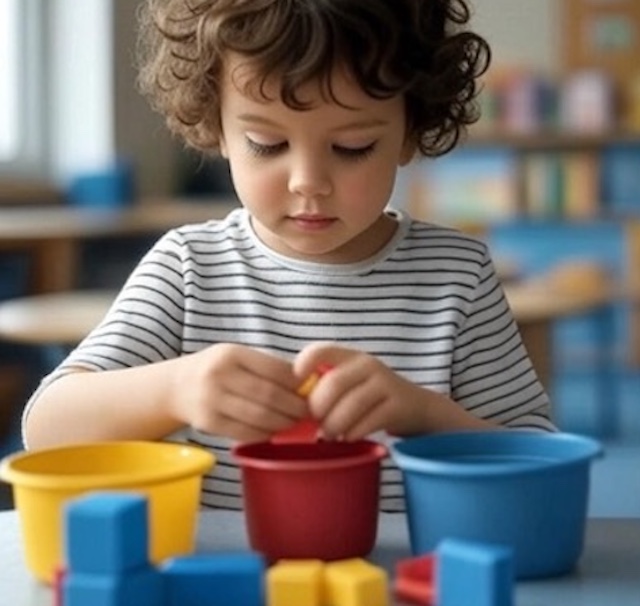
Seven Concrete Experiences That Build Mathematical Minds.
- Classification and Sorting Activities that involve organizing objects by attributes build the cognitive foundations for sets and logical relationships.
Quick tip: Provide collections of objects with multiple attributes (size, colour, shape) and observe how your child creates categories. This seemingly simple activity develops sophisticated mathematical thinking.
- Comparing and Measuring Experiences that involve determining “more,” “less,” “longer,” “heavier,” etc., develop the quantitative reasoning fundamental to mathematical thinking.
Personal anecdote: My daughter’s extensive play with our balance scales at age 4 developed intuitive understanding of equality and inequality that made algebraic equations remarkably accessible years later.
- Creating and Extending Patterns Activities that involve recognizing and continuing sequences develop the pattern awareness central to mathematical thinking.
Classroom observation: Children who regularly work with pattern activities demonstrate greater ease with algebraic concepts in elementary years compared to those with limited pattern experience.
- Counting with Meaning Experiences that connect number words, quantities, and symbols build true numerical understanding.
At-home approach: With my own children, we emphasized counting real objects of interest rather than rote recitation of numbers. This meaningful counting developed deeper numerical understanding.
- Constructing with Shapes Building with blocks and geometric shapes develops spatial reasoning and geometric understanding.
Director’s insight: Our students who engage extensively with 3D construction in early years consistently show stronger spatial problem-solving and geometric reasoning in later mathematics.
- Part-Whole Relationships Activities exploring how quantities can be composed and decomposed build the foundations for operations and algebraic thinking.
Classroom example: Working with number rods where children physically experience how smaller numbers combine to make larger numbers develops intuitive understanding of addition and subtraction.
- Experiencing Mathematical Relationships Hands-on work with materials that embody mathematical principles allows children to discover these relationships themselves.
Personal experience: My son’s work with fraction circles, physically comparing and combining different fractions, gave him an intuitive understanding that made later abstract fraction operations logical rather than mysterious.
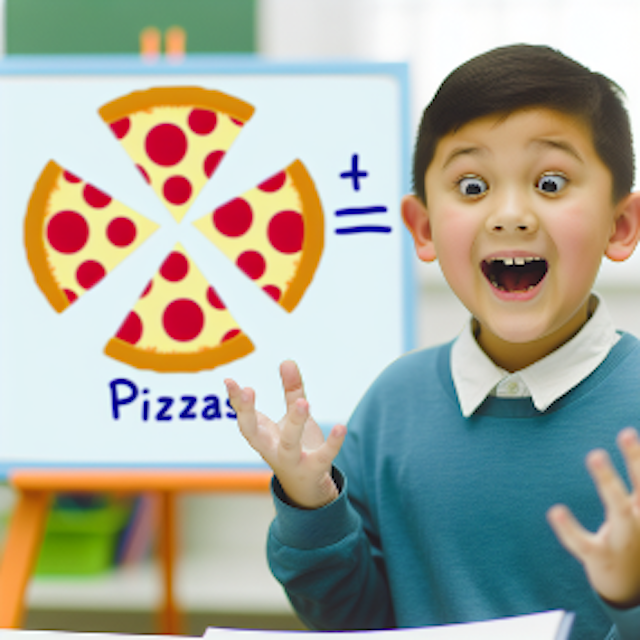
Misconceptions and Missteps: Common Challenges in Mathematical Development.
The Symbol-First Trap Perhaps the most prevalent mistake is introducing mathematical symbols before children have developed concrete understanding of the concepts those symbols represent. This creates the illusion of mathematical learning without building true understanding.
The Acceleration Confusion Pushing children toward abstract calculations before they’ve established concrete foundations often leads to short-term performance but long-term mathematical insecurity.
The Narrow Definition Viewing mathematics primarily as computation rather than a broad way of understanding patterns and relationships limits children’s mathematical development.
Personal approach: With my own children, we prioritized mathematical thinking over calculation speed. This focus on understanding has served them well into advanced mathematics, where creative problem-solving matters more than computational fluency.
Director’s recommendation: If your child is struggling with a mathematical concept, return to concrete representations. Even for older children wrestling with advanced concepts, physical models can often clarify abstract relationships that remain confusing in symbolic form.

From Concrete to Abstract: How Material Experiences Become Mathematical Thinking.
The Concrete Foundation Children who work extensively with mathematical materials develop mental structures that represent mathematical concepts. These aren’t just memories of activities but internal frameworks for understanding.
The Power of Discovery Mathematics understood through personal discovery becomes permanent knowledge rather than temporarily memorized procedures.
Personal evidence: Both my teenagers approach mathematical challenges with confidence I attribute directly to their early concrete experiences with mathematical concepts. When they encounter new mathematical ideas, they instinctively look for underlying patterns and relationships rather than memorizing formulas.
The Joy Factor Perhaps most importantly, children who develop mathematical understanding through concrete exploration maintain curiosity and enjoyment of mathematics.
Classroom to career: I’ve stayed connected with many alumni now working in STEM fields. Remarkably often, they cite their early hands-on mathematical experiences as fostering a lifelong positive relationship with mathematics.
Integration of Mathematical Thinking When developed through concrete experience, mathematical thinking becomes integrated with other forms of reasoning rather than compartmentalized as a separate skill.
Students who develop mathematical thinking through concrete experience naturally apply mathematical reasoning across disciplines, seeing mathematics as a tool for understanding rather than an isolated subject.

Starting Today: Creating Concrete Mathematical Experiences at Home.
Provide Rich Counting Opportunities Look for authentic reasons to count with your child—stairs as you climb them, plates as you set the table, toys as you put them away. Meaningful counting builds stronger number sense than abstract practice.
Quick tip: When counting with your child, encourage them to touch or move each object as they count. This physical connection strengthens the link between quantity and number.
Use Precise Mathematical Language Incorporate mathematical vocabulary naturally into daily interactions: “Would you like your sandwich cut into halves or quarters?” “Let’s sort your blocks by shape before putting them away.”
Personal experience: The mathematical vocabulary used casually in our home provided my children with language tools that later helped them articulate complex mathematical concepts.
Ask Questions That Promote Mathematical Thinking Instead of teaching mathematical facts, pose questions that invite exploration: “I wonder how many more blocks you’ll need to make your towers the same height?” “Do you think we have enough chairs for everyone coming to dinner?”
Director’s insight: I’ve noted that children who regularly engage with open-ended mathematical questions develop stronger problem-solving abilities than those who primarily receive direct instruction.
Find Mathematics in Everyday Activities Cooking, shopping, building, and gardening all offer rich, authentic mathematical experiences. These practical applications make mathematical concepts meaningful.
Home approach: In our family, baking became an exploration of fractions, measurement, and proportional relationships. These kitchen-table mathematics lessons provided more lasting understanding than any worksheet could offer.
Create Opportunities for Mathematical Discovery Rather than explaining mathematical concepts, create situations where your child can discover these principles themselves.
The delight of mathematical discovery—that “aha!” moment when a pattern or relationship becomes clear—creates stronger neural connections than being told the same information.
Value Mathematical Thinking Over Speed Emphasize deep understanding and creative problem-solving rather than quick calculations. The most valuable mathematical abilities involve seeing relationships and approaching problems flexibly.
Looking Forward: Mathematical Thinking as a Life Skill.
As I’ve watched Montessori children grow into adults, I’ve been struck by how their early mathematical experiences shape their approach to challenges far beyond mathematics itself.
In our increasingly data-driven world, mathematical thinking has become essential for informed citizenship and professional success. By ensuring children develop this thinking through meaningful concrete experiences, we provide them with more than academic skills—we offer tools for understanding and navigating their world.
In our next “Growing Minds” blog post, we will dive into “The role of imagination and creativity in child development”. Until then, I encourage you to notice the mathematical opportunities that already exist in your daily interactions with your child, and to approach mathematics not as a subject to be taught but as a fascinating way of thinking to be discovered together.
,,
