
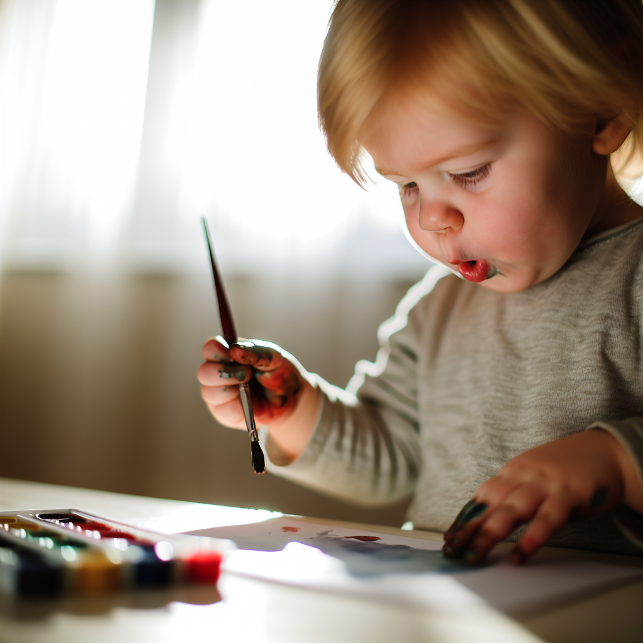
Nurturing Innovation in Early and Middle Childhood.
Welcome to the sixth instalment of our “Growing Minds” blog series at Kids Channel Montessori! Today, we’re exploring how creativity and innovation develop from birth through age eleven—and why supporting this natural capacity is essential for raising adaptable, resourceful human beings.
The Creativity Crisis.
A few years ago, I observed a scene that’s become increasingly common in my years as a Montessori Director. A seven-year-old stood before empty art materials, paralysed by uncertainty. “But what should I make?” he asked repeatedly, growing visibly anxious when told he could create anything he wished. After several minutes of hesitation, he tentatively asked, “Can you just show me what to do?”
This moment exemplifies what researchers have documented as a concerning trend: declining creative capacity in children despite our cultural celebration of innovation. After decades guiding both Montessori environments and my own children’s development, I’ve witnessed how certain approaches nurture natural creativity while others subtly extinguish it.
True story: That hesitant seven-year-old eventually embraced the creative process after encouragement and permission to experiment without predetermined outcomes. His journey from creative paralysis to joyful innovation illustrates how children can reclaim their innate creative capacities when given the right conditions.
The development of creativity isn’t just about producing art—it’s about cultivating the fundamental human capacity to envision possibilities beyond what already exists.
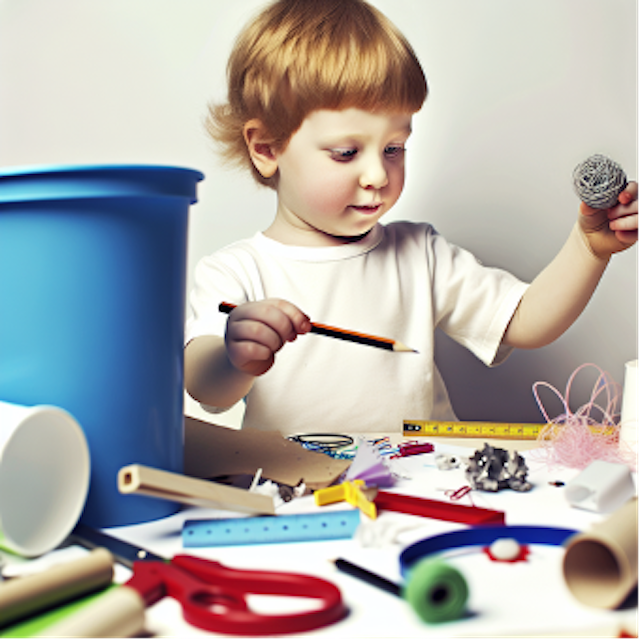
The Science of Developing Creativity.
Understanding how creativity naturally develops helps us support rather than inadvertently hinder this essential capacity.
The Neurological Foundations Creative thinking engages multiple brain networks simultaneously, integrating logical reasoning with emotional processing and memory retrieval in unique patterns.
Research note: Neuroimaging studies reveal that creative processes activate both focused attention networks and the default mode network associated with imagination and idea generation—a collaboration of neural systems that strengthens through practice and weakens with disuse.
The Developmental Progression Creativity follows a natural developmental arc that builds complexity through predictable stages when appropriately nurtured.
Director’s observation: I’ve consistently observed how creative capacity follows cognitive development, with children’s innovations becoming increasingly complex, abstract, and intentional as they mature—provided their environment supports this progression.
The Psychological Components Creativity requires specific psychological conditions that either flourish or diminish based on environmental factors.
Personal experience: When my daughter’s creative confidence faltered in early elementary years, we discovered that reducing evaluation anxiety and increasing psychological safety dramatically restored her willingness to take creative risks. This experience fundamentally shaped my approach to supporting creative development both at home and in our Montessori environments.

Four Phases of Creative Development.
There are four distinct phases in the development of creativity through age eleven, each with unique characteristics and needs:
- Sensory Creativity (Birth to Age 3)
During these formative years, children establish the foundations of creative thinking through sensory exploration and discovery of cause and effect.
Key Developmental Processes:
- Material investigation without predetermined outcomes
- Repetition with variation
- Unexpected combinations of objects and actions
- Discovery of cause-effect relationships
- Open-ended sensory play
Classroom approach: Toddler environment should provide abundant opportunities for sensory exploration with materials that respond to different actions, building the experiential foundation for later creative thinking.
Personal example: When my son was two, we created a “discovery basket” with unusual natural objects that changed weekly. His increasingly inventive interactions with these materials—stacking, rolling, combining in unexpected ways—built neural pathways for divergent thinking that later expressed in more sophisticated creative endeavours.
Common Obstacle: Adult concern with “correct use” of materials often limits the experimental manipulation essential for early creative development.
Creativity Milestone: The transition from using objects as intended to repurposing them in novel ways signals healthy development in this phase.
- Symbolic Creativity (Ages 3-6)
Children in this stage develop the ability to represent ideas through various media and engage in imaginative transformation of reality.
Key Developmental Processes:
- Symbolic representation
- Dramatic play and role-taking
- Narrative construction
- Material transformation
- Metaphorical thinking
Classroom evidence: I have observed countless children working in amazing ways. The blue fabric scraps in our practical life area undergo a remarkable symbolic journey on a regular basis. For example, Maya would the scrunch the fabric into a rippling pattern, becoming “the ocean.” Then it is gathered it into a bundle, transforming it into “a baby that needs care.” Minutes later, it is draped over shoulders as “a superhero cape that makes me invisible.” Finally, it is folded precisely, it is now “a special map to treasure.” In this single session, Maya demonstrated the extraordinary symbolic flexibility characteristic of this developmental stage.
Director’s insight: The four-year-old who transforms a wooden block into a phone, then a camera, then a sandwich within a single play sequence demonstrates greater creative fluency than older children who have lost this symbolic flexibility through excessive exposure to single-purpose toys.
Common Obstacle: Highly realistic toys and media with predetermined narratives often constrain the symbolic transformation essential for creative development at this stage.
Creativity Milestone: The capacity to imagine and express “what could be” rather than merely representing “what is” marks successful development in this domain.
- Systematic Creativity (Ages 6-9)
During this critical period, children develop the ability to apply creative thinking within systems and structures, combining imagination with growing logical capabilities.
Key Developmental Processes:
- Pattern recognition and extension
- Systematic variation of elements
- Rule-based innovation
- Intentional combination of disparate ideas
- Planning creative processes
Parent experience: When my son became interested in coding at age eight, we supported his exploration with basic programming tools. Rather than following prescribed projects, he delighted in creating his own games by systematically experimenting with different variables and commands—applying creative thinking within logical structures.
Common Obstacle: Excessive focus on single “correct” approaches to academic subjects can prevent children from developing flexible thinking within knowledge domains.
Creativity Milestone: The ability to generate multiple solutions to structured problems signals healthy creative development at this stage.
- Collaborative Creativity (Ages 9-11)
Pre-adolescents develop the capacity for creative collaboration, building on others’ ideas and integrating multiple perspectives into innovative approaches.
Key Developmental Processes:
- Idea exchange and development
- Integration of diverse perspectives
- Creative problem-solving in groups
- Constructive evaluation of ideas
- Innovation within social contexts
25-year observation: Our upper elementary students who engage regularly in collaborative creative projects demonstrate significantly stronger innovation capabilities than those whose creative experiences are primarily solitary.
Personal approach: When my daughter participated in a school theatre program at age ten, we witnessed how the collaborative creative process stretched her thinking beyond what she could generate independently. Building on others’ ideas and integrating diverse perspectives fundamentally expanded her creative repertoire.
Common Obstacle: Competitive educational approaches often inhibit the idea-sharing essential for collaborative creativity to flourish.
Creativity Milestone: The ability to build upon others’ ideas rather than simply defending one’s own signals healthy development in this domain.
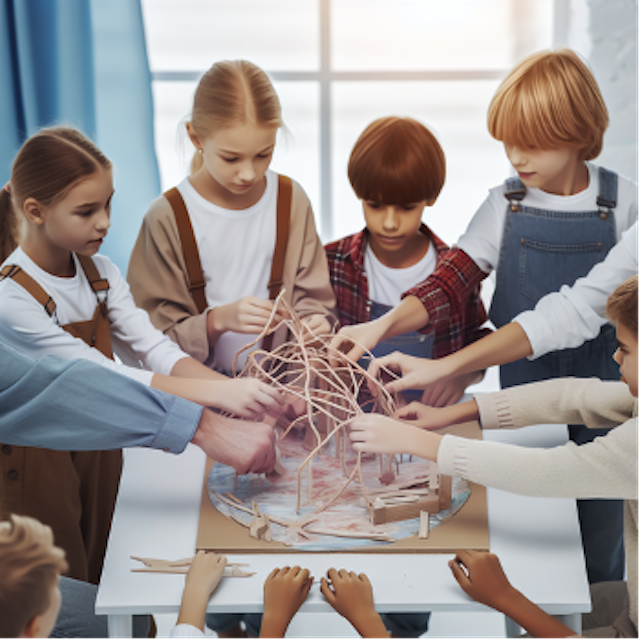
The Creative Environment: Space, Time, and Attitude.
The Physical Environment Creative thinking flourishes in spaces designed to inspire exploration and support diverse modes of expression.
Home adaptation: In our family, we established a “creation station” with accessible, well-organized materials that could be used independently. This dedicated space communicated that creative expression was valued enough to merit physical prominence in our home.
The Temporal Environment Creativity requires unhurried time for ideas to develop, transform, and sometimes fail before succeeding.
Director’s insight: After observing children’s creative processes, I’ve found that their most innovative work emerges when they have extended, uninterrupted time periods rather than brief activity sessions.
Family practice: We established “slow Saturdays” when schedule pressures were minimized, allowing creative projects to unfold at their natural pace. The depth and originality of work produced during these unhurried times consistently exceeded what emerged during more time-constrained periods.
The Attitudinal Environment The adult’s approach to novelty and risk-taking establishes the psychological safety essential for creative development.
Classroom evidence: Teachers who respond to unusual ideas with genuine curiosity rather than evaluation foster significantly more creative expression than those who focus primarily on correctness or conventional thinking.
Personal reflection: One of my most important parenting evolutions was learning to respond to my children’s unusual ideas with “That’s interesting—tell me more” rather than immediate evaluation or correction. This simple shift dramatically increased their willingness to share innovative thinking.

Four Creativity Killers: Modern Challenges to Innovative Thinking.
The Consumption Orientation Excessive exposure to produced content creates passive entertainment patterns that displace active creation.
Director’s response: We’ve structured our environments to emphasize production over consumption, ensuring children regularly experience the deeper satisfaction of creating rather than merely consuming.
Children with limited media exposure typically demonstrate significantly greater creative fluency, originality, and enjoyment of the creative process than those with heavy consumption patterns.
The Perfection Expectation Social media and professional-level children’s materials have elevated expectations for “successful” creative outcomes, increasing performance anxiety.
Home strategy: In our family, we emphasized the value of “beautiful mistakes”—celebrating failed attempts and unexpected outcomes as essential parts of the creative journey.
Quick tip: Display imperfect process work alongside more finished pieces to communicate that exploration holds equal value to polished outcomes.
The Overscheduled Day Today’s children often move between highly structured activities with insufficient time for the meandering exploration that generates innovative thinking.
Classroom observation: Students who experience regular unstructured time demonstrate measurably stronger creative thinking skills than those whose days are entirely programmed.
Parent approach: We intentionally limited our children’s scheduled activities to allow ample time for unstructured creative exploration—providing the “margin” in which innovation naturally emerges.
The Early Emphasis on Production Premature focus on creating recognizable end products can interfere with the experimental process essential for creative development.
Home adaptation: Make art experiences a process to explore before introducing representational techniques, building comfort with creative experimentation that transfers to other domains. Much better to create 10 pieces of work which are all different than one piece aiming for perfection.
Director’s insight: Children who develop comfort with open-ended creative processes in early years demonstrate stronger innovation capabilities across academic domains than those whose creative experiences focused primarily on producing specific outcomes.

Creativity Milestones: A Developmental Roadmap.
Early Childhood (Ages 2-5)
- Uses materials in unexpected ways
- Creates simple stories with imaginative elements
- Engages in pretend play with symbolic substitutions
- Asks “what if” questions
- Combines materials to create novel objects
- Shows interest in process rather than predetermined outcomes
- Experiments with artistic media without concern for representation
- Seeks multiple uses for common objects
Director’s observation: Children who demonstrate these indicators by age five typically approach elementary learning with greater problem-solving flexibility and engagement.
Family example: When my daughter transformed our living room into an elaborate “hospital for stuffed animals” at age four—repurposing household items as medical equipment and creating detailed treatment protocols—her symbolic fluency demonstrated healthy creative development that later translated to strong academic problem-solving.
Middle Childhood (Ages 6-11)
- Generates multiple solutions to problems
- Creates complex narratives with original elements
- Demonstrates ability to extend patterns in novel ways
- Shows willingness to revise ideas based on feedback
- Combines knowledge from different domains to create new approaches
- Demonstrates comfort with ambiguity and open-ended challenges
- Asks unusual questions that extend beyond conventional thinking
- Shows originality in academic contexts beyond arts
Classroom evidence: Upper elementary students who display these indicators consistently demonstrate stronger learning outcomes across content areas than those with less developed creative capacities.
Personal example: When my son approached a history project by creating an imaginary journal from multiple perspectives rather than a standard report, this integration of historical knowledge with creative expression demonstrated healthy development of his innovative thinking.

Nurturing the Creative Spirit: Practices for Parents and Educators.
- Provide Creative Raw Materials Offer open-ended materials that can be transformed and combined in countless ways rather than single-purpose items.
Home application: In our family, we prioritized “possibility materials” like blocks, fabric scraps, natural objects, and recyclables over toys with predetermined functions. The diversity and complexity of my children’s creations with these simple materials consistently exceeded what emerged from more structured materials.
Quick tip: Create a “loose parts” collection of interesting objects without obvious purposes—buttons, wood pieces, natural materials, unusual containers—and observe how these catalyse creative thinking.
- Ask Divergent Questions Pose questions that invite multiple possible answers rather than those seeking a single correct response.
Family example: When discussing stories or situations with my children, I learned to ask “What might happen next?” or “How else could this problem be solved?” rather than questions with predetermined answers. These open inquiries consistently generated more original thinking.
Director’s insight: Children who regularly experience divergent questioning develop measurably stronger creative thinking skills than those primarily asked convergent questions with single correct answers.
- Model Creative Risk-taking Demonstrate your own willingness to experiment, make mistakes, and try unexpected approaches.
Home strategy: Try intentionally working on creative projects alongside your children, authentically modelling both the challenges and satisfactions of the creative process.
Personal reflection: When I began learning pottery while my children were in elementary school, sharing both my struggles and breakthroughs provided a powerful model of creative persistence that I observed them internalizing in their own projects.
- Establish Creativity Rituals Create regular times and protocols for generative thinking.
Children who experience consistent creative routines demonstrate stronger innovative thinking than those whose creative opportunities are sporadic or unpredictable.
Home strategy: In our household, we played “What If ” dilemmas, when dinner conversation centred around imaginative scenarios and hypothetical questions. This simple ritual noticeably enhanced my children’s comfort with speculative thinking in other contexts.
- Practice Response Restraint Monitor reactions to unusual ideas, replacing evaluation with curiosity.
Classroom evidence: Students whose unusual ideas are met with interest rather than immediate correction demonstrate significantly greater creative risk-taking over time.
Quick application: Practice responding to unexpected ideas with phrases like “Tell me more about that,” “How did you think of that?” or “That’s an idea I hadn’t considered” before offering any evaluation.
- Create Collection Systems Establish methods for capturing creative inspirations and works in progress.
Director’s perspective: Children who learn to document their creative process through portfolios, idea journals, or digital collections demonstrate greater creative continuity and development than those without systematic collection methods.
Family example: When my son showed interest in invention ideas, we created a simple “innovation journal” where he could draw concepts and note ideas. This collection system validated his thinking while creating a record that inspired further ideation.
- Foster Cross-Pollination Intentionally connect different knowledge domains and experiences to spark innovative combinations.
Personal approach: We regularly practiced finding unexpected connections between seemingly unrelated topics, playing games like “How is math like cooking?” or “What does music have in common with architecture?” These exercises strengthened my children’s ability to transfer concepts across domains—a fundamental creative skill.
Children who regularly experience interdisciplinary connections demonstrate significantly stronger innovative thinking than those educated in strictly separated subject areas.

Addressing Creative Blocks: Recognition and Response.
The Perfection-Paralyzed Child Children who show extreme reluctance to begin creative tasks or abandon projects at the first imperfection often suffer from performance anxiety that requires specific intervention.
Director’s insight: Perfectionism in creative contexts typically stems from internalized evaluation anxiety rather than authentic quality standards, requiring environment modification rather than simply encouragement.
Intervention approach: Temporarily removing all evaluation language (including praise) while emphasizing process enjoyment often liberates creative expression more effectively than reassurance about outcomes.
The Permission-Seeking Child Children who repeatedly ask what to create or how to proceed may have experienced excessive direction that diminished their creative self-efficacy.
Home strategy: Gradually reduce directions through careful questioning that returns creative authority to the child: “What do you think might work here?” or “Which one feels more interesting to you?”
Personal experience: When my daughter went through a period of creative hesitancy after a particularly directive school experience, we tried a “no instructions” creative time where the only requirement was self-direction. This deliberate practice of autonomous creation gradually restored her creative confidence and I got to craft it up as well!
The Rigidly Realistic Child Children who reject imaginative elements or insist on exact representation often need specific support to reclaim creative flexibility.
Home strategy: Introduce art exercises with deliberate absurdity—impossible animals, machines with fantastic functions, or illustrations of metaphorical expressions taken literally—to rebuild comfort with imaginative thinking.
Children who develop rigid adherence to realism often respond positively to gentle exposure to surrealist art, nonsense literature, and other examples of celebrated imaginative deviation from literal representation.

The Creative Dividend: Long-term Benefits Beyond the Arts.
From Artistic Expression to Problem-Solving Versatility Children who develop strong creative foundations consistently demonstrate greater flexibility when facing academic and practical challenges.
Classroom evidence: Students with strong creative backgrounds typically generate more diverse approaches to mathematical problem-solving than those with less developed creative capacities.
Director’s observation: The progression from creative exploration to innovative problem-solving represents a critical transfer of cognitive flexibility across domains.
From Imaginative Play to Hypothetical Thinking Early comfort with imagination builds capacity for the hypothetical reasoning essential in advanced academic thinking.
Personal observation: My children’s early immersion in imaginative play built neural foundations for the “what if” thinking they later applied to science experimentation and historical analysis in upper elementary years.
From Creative Risk-Taking to Learning Resilience Children who regularly experience the creative cycle of attempt, failure, and revision develop broader academic resilience.
Parent perspective: When my son faced challenging mathematics concepts, I observed him apply the same persistence and comfort with imperfection he had developed through creative pursuits, viewing initial confusion as part of a learning process rather than evidence of incapacity.

Beginning Tomorrow: Three Practices for Nurturing Creative Development.
Establish a Creation Station Designate a specific area with organized, accessible materials for independent creative exploration.
Quick application: Begin with simple materials that can be combined in multiple ways—paper in various forms, joining materials (tape, glue, clips), mark-making tools, and interesting recyclables. Add and rotate materials based on observed interests.
Director’s insight: Children with regular access to organized creative materials engage in significantly more spontaneous creative activity than those who must request supplies or assistance to begin creative work.
Implement Daily Divergent Thinking Incorporate a simple routine that exercises the “creativity muscles” through regular practice.
Family practice: In our home, we established a dinnertime ritual of “unusual uses”—identifying novel purposes for common objects. This simple daily exercise measurably enhanced my children’s flexible thinking across contexts.
Quick tips:
- Ask “What could this become?” about everyday objects
- Play “fortunately/unfortunately” storytelling games
- Practice “what if” thinking about ordinary situations
- Generate multiple ways to solve simple problems
Create a “Beautiful Mistakes” Gallery Explicitly celebrate creative attempts that didn’t work as planned but provided valuable learning.
Personal experience: When we began displaying “beautiful mistakes” alongside successful projects, my children’s creative risk-taking noticeably increased. This simple practice powerfully communicated that exploration held greater value than perfection.
Home strategy: Keep a “Learning from Attempts” display, where your child can see the unsuccessful approaches which led to the finished project. This can significantly reduce creative hesitancy by normalizing the trial-and-error nature of innovation.
Looking Forward: Creativity as Essential Preparation
As I watched the elementary children in school who experienced strong creative development in their early years, I continue to witness how this foundation prepares them for an increasingly complex world. The child who learned to generate multiple possibilities in art approaches mathematical problem-solving with the same divergent thinking. The young student who developed comfort with creative ambiguity navigates social complexities with similar flexibility. The child who learned to connect disparate ideas in storytelling applies similar innovative combinations in scientific hypothesizing.
Creative development in early childhood isn’t valuable just for artistic expression. Its true worth emerges in the cognitive flexibility, innovative problem-solving, and comfort with uncertainty it builds—capacities increasingly essential in a rapidly changing world.
In our next “Growing Minds” blog post, I’ll explore how children develop empathy and social understanding through the early stages of development. Until then, I encourage you to ask the transformative question that nurtures creativity: “I wonder what would happen if…?”
,,
